
What's actually happening to your limestone.
Limestone is a soft, calcium-based stone. It reacts to acid, weight, and time. Here are the four things that usually show up first, and what each one means.

Etching
Dull, cloudy spots where wine, citrus, tomato, coffee, or a cleaner sat too long. The surface looks washed out, sometimes rough to the touch. Not a stain. A chemical reaction that removed a thin layer of the stone.

Scratches and wear paths
Thin lines and dulled tracks in the kitchen work zone, the entryway, the hallway to the bedrooms. Everyday traffic and grit acting like sandpaper on a soft surface.
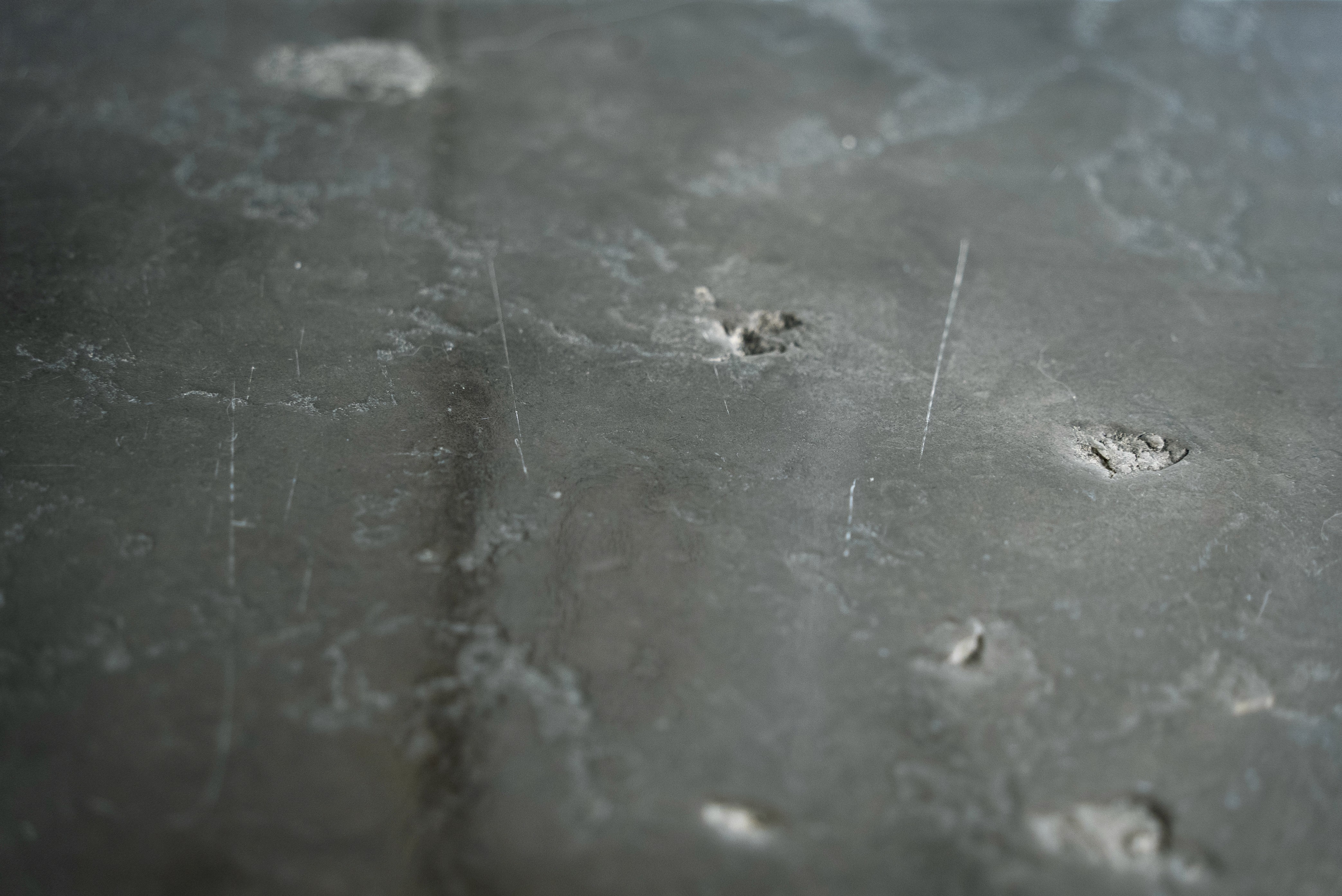
Pits and holes
Natural voids in the stone that widen with use, especially on honed limestone counters and floors. Polishing around a pit leaves the pit. Filling it is the craft step that closes it.

Dulling and discoloration
The factory finish worn away, patches that look flat next to areas that still catch light. This is not permanent. The finish can be brought back, or intentionally changed to something easier to live with.
Restore, surpass, or change the factory finish.
Limestone was cut and finished by a fabricator years before it landed in your home. Today you have three real options. Not one.

Restore.
Return the current finish to the condition it was in the day it was installed. Honed matte, satin, or polished, depending on what your limestone left the shop as. The most common request, and the right one for most homes.

Surpass.
Take a dull or worn matte floor and hone it to a higher, more refined finish than the piece came with. On the right limestone, we can push a satin sheen or a soft honed glow that reads more finished than the original.

Change.
Convert a polished counter to a soft honed look for easier maintenance. Or take a worn matte floor to a light satin sheen so it wipes clean. The finish is a choice, not a fixed outcome.
The pit-and-hole work most restorers walk past.
Marble, travertine, and limestone all pit as the stone wears. Closing those voids is a craft step most vendors quietly skip. We don't.
A polished-around pit is still a pit. On a honed limestone counter or a well-lit floor, it stays visible from every angle. Filling is a craft step: we identify the void, mix a filler tinted to the exact stone color and vein, work it into the surface, and integrate the fill so it reads as the stone, not a patch. It is the difference between a cleaner floor and a restored one.

Erin Newton, Pure Light™ residential customer
9 months ago
" width="48px"/><path d="M 23.04 4.91 C 23.042 3.264 22.896 1.62 22.604 0 L 0 0 L 0 9.295 L 12.916 9.295 C 12.349 12.284 10.647 14.815 8.094 16.517 L 8.094 22.56 L 15.884 22.56 C 20.422 18.371 23.04 12.219 23.04 4.91 Z" fill="rgb(66, 133, 244)" height="22.56px" id="hEgMm5Vux" transform="translate(24 19.636)" width="23.04001243775513px"/><path d="M 21.425 19.418 C 27.905 19.418 33.338 17.28 37.309 13.614 L 29.519 7.571 C 27.381 9.011 24.654 9.884 21.425 9.884 C 15.185 9.884 9.883 5.672 7.985 0 L 0 0 L 0 6.196 C 3.949 14.029 12.043 19.418 21.425 19.418 Z" fill="rgb(52, 168, 83)" height="19.418px" id="lu_CTrY37" transform="translate(2.575 28.582)" width="37.309px"/><path d="M 10.56 15.316 C 10.061 13.847 9.803 12.307 9.796 10.756 C 9.796 9.163 10.08 7.636 10.56 6.196 L 10.56 0 L 2.575 0 C 0.881 3.332 -0.002 7.018 0 10.756 C 0 14.64 0.938 18.283 2.575 21.512 L 8.793 16.669 Z" fill="rgb(251, 188, 5)" height="21.512px" id="o9N41Q3sx" transform="translate(0 13.244)" width="10.560002771839168px"/><path d="M 21.425 9.556 C 24.96 9.556 28.101 10.778 30.61 13.135 L 37.483 6.262 C 33.316 2.378 27.905 0 21.425 0 C 12.043 0 3.949 5.39 0 13.244 L 7.985 19.44 C 9.883 13.767 15.185 9.556 21.425 9.556 Z" fill="rgb(234, 67, 53)" height="19.439999999999998px" id="wNlPBCzUS" transform="translate(2.575 0)" width="37.483px"/></g></svg>)
"He didn't just put sealant over it. He went and made the color match. You can't see it anymore."
The standard you hire is the standard that shows up.
Step 1
Free in-home estimate, Stone ID kit on site.
We identify the exact stone and finish in your home, not from a photo. Honest scope, honest number, and if the right answer is leave it as it is, we say so.
Step 2
Tech photo and ETA, texted the day of.
You see who is coming to your door and when, before they get there.
Step 3
Pre-job walkthrough with you.
We walk the surface with you, confirm the scope, flag any spots that need special attention, and answer questions before any product touches the stone.
Step 4
Multi-method work.
If our first method doesn't solve it, we adjust methods until the expected result is achieved, within the realistic boundaries of the surface.
Step 5
Post-job walkthrough, plus a day-after satisfaction call.
We walk the finished surface with you, hand off care notes, and follow up the next day to make sure it's still right in the light you actually live in.
After restoration.

The only coating that stops etching from happening again.
If your limestone lives near wine, citrus, or acidic cleaners, restoration alone won't stop the next etch. MORE™ AntiEtch™ is the coating built for it. Pure Light™ is 1 of only 2 certified applicators in San Diego County, and every new application ships with a lifetime warranty against stains and etches. If your restored surface will keep taking the hits that dulled it in the first place, this is what actually holds.
Real San Diego homes. Real limestone. Real reactions.
Limestone was cut and finished by a fabricator years before it landed in your home. Today you have three real options. Not one.
Erin Newton, Pure Light™ residential customer
9 months ago
"From the very beginning, they were always clear and concise. They send you a text the morning of, showing you a picture of who's coming and what time they're coming. It's a pleasure to make the call."
The five questions we get about limestone.
Can you actually get the etch marks out of my limestone counter?
Most of the time, yes. Etches sit on the top layer of the stone. We hone that layer back until the surface reads uniform again. On deep etches or older damage, the honest answer is that we get it very close, not perfect. If our first method doesn't solve it, we adjust methods until the expected result is achieved, within the realistic boundaries of the surface.
Isn't limestone too soft to polish? Do I have to keep the matte look?
No. Limestone works across a range of finishes, from honed matte, to satin, to polished. Your original finish was a fabricator's choice years ago. In an estimate, we walk you through what your specific slab or floor can take and what will hold up in your space. Restore, surpass, or change. Your call.
Won't sealing my limestone stop this from happening again?
A sealer is not a coating. A penetrating sealer soaks into the stone and helps against staining, but etching happens above the sealer, on the surface, from acids like wine, citrus, and cleaners. Sealers also wear over time, especially with harsh products. If your goal is to actually stop etching in a wet or acidic area, ask about MORE™ AntiEtch™, which is the coating built for that job.
How long does a limestone floor or counter restoration take?
Most residential limestone restorations run one to two days on site. Larger floors or extensive pit-and-hole work can add a day. In the estimate we give you a realistic window and a plan for how the room will be used while we're there.
Are you certified to work on high-end limestone? Do you actually know the difference between honed and polished?
Yes, and yes. Cameron Stewart is Pure Light™'s founder and the national trainer for MB Stone restoration west of the Mississippi. Every technician on your job is certified through Pure Stone Care and MB Stone. When we ask what finish you want, it's because we can actually deliver it.
Related surfaces we care for.


Your limestone, back to the finish you want.
If our first method doesn't solve it, we adjust methods until the expected result is achieved, within the realistic boundaries of the surface.